



Red light therapy has gained significant attention in recent years within skincare and skin health. For many, it appears to be a new trend, but in reality, the technology is built upon decades of research in what is called photobiomodulation, that is, how light affects biological processes in the body.
What makes red light therapy particularly interesting is that its effect does not primarily occur on the skin's surface. Instead, specific wavelengths of light affect the cells themselves, especially the mitochondria, the cells' energy-producing units. When these are stimulated, ATP production increases, which is the energy cells use to repair, renew, and maintain normal functions.
The most studied wavelengths in red light therapy are in the range of 630 to 660 nanometers, red light, and 800 to 850 nanometers, near-infrared light. These wavelengths penetrate the skin at different depths, affecting both superficial and deeper layers of the tissue. This is an important part of the explanation for why red light therapy not only provides a temporary glow but can contribute to more long-term improvements in skin structure and quality.

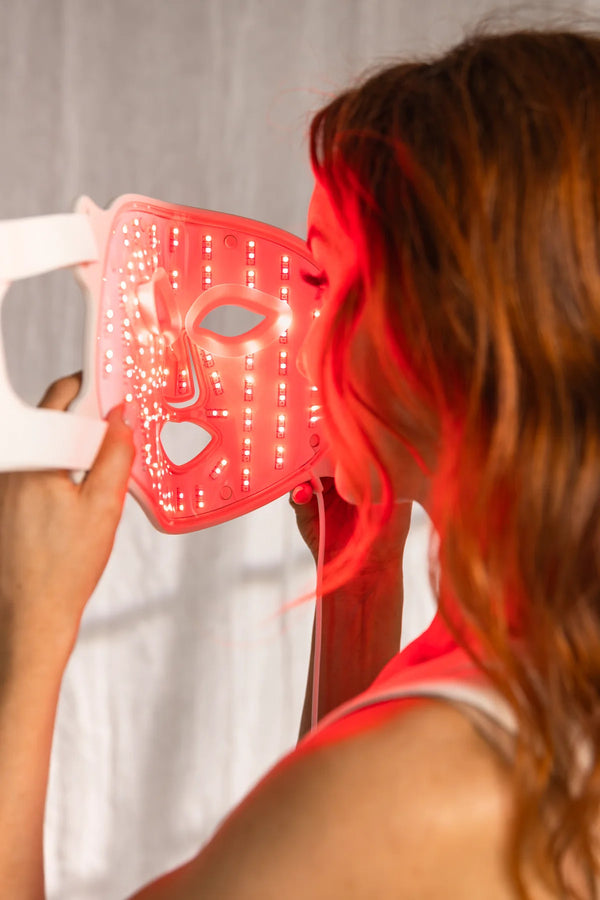
LumaRed Glow Therapy Mask Advanced red light mask for face, neck, and chest, developed for visible skin improvement.
One of the most cited clinical studies in this field was published by Lee and colleagues in 2007. This was a randomized, placebo-controlled study (RCT) with 76 participants, investigating the effect of LED light with wavelengths of 633 and 830 nanometers. The results showed not only a visible reduction in wrinkles and improved skin structure but also increased collagen production. What makes this study particularly interesting is that the results were also confirmed through histological analyses, meaning by examining skin tissue under a microscope. The changes were, in other words, not just cosmetic but biologically measurable in the skin¹.
Similar findings have been reported in several studies. Russell and colleagues published a clinical study in 2005 showing that treatment with red LED light could increase collagen production and improve skin firmness and structure. Although this was not a classic RCT, the study is often referenced because it documents clear biological effects in the skin.

In a study by Barolet and Boucher from 2010, which used a split-face design, increased activity in fibroblasts, the cells that produce collagen, was observed, along with clear improvements in the skin that had only been treated with light. Although this was not a fully randomized RCT, this type of design is considered methodologically strong because it compares treated and untreated skin on the same person²³.
When examining the research collectively, the picture becomes even clearer. A systematic review by Avci and colleagues from 2013, which includes several RCT studies, concludes that red light therapy can increase ATP production, stimulate collagen and elastin, reduce inflammation, and support the skin's natural repair processes⁴. This supports the understanding of red light therapy as more than a cosmetic treatment; it is a method that affects the skin's function at a biological level.
Another important finding in the research is that the combination of different wavelengths appears to yield better results than a single wavelength alone. Studies, including those by Goldberg and Russell, show that the combination of red and near-infrared light can produce a deeper and more comprehensive biological response in the skin⁵.
In addition to red and near-infrared light, blue light, typically around 415–460 nanometers, is also well-documented in the treatment of acne. Blue light works by activating porphyrins in Cutibacterium acnes, which leads to the formation of reactive oxygen species that destroy the bacteria. Clinical studies have shown a reduction in acne breakouts with the use of blue LED light⁶.

At the same time, how the light is used is crucial. The effect of red light therapy depends not only on the wavelengths but also on light intensity and dose. In most clinical studies, irradiance is between 10 and 50 mW/cm², and the energy dose is between approximately 20 and 60 J/cm² per treatment. This is considered a range where good biological effect is achieved without overstimulating the tissue.
It is precisely this balance that often distinguishes products with real effects from those that yield limited results. Red light therapy is therefore not just light; it is a precise form of energy that must be delivered correctly to function optimally.
This is also where modern, well-thought-out solutions stand out. By combining several clinically studied wavelengths, including red, near-infrared, and blue light, with the correct light intensity and dose, it is possible to provide the skin with the same conditions used in research, adapted for safe and effective home use.
In summary, research shows that red light therapy, when used correctly, can contribute to increased collagen production, improved skin structure, better elasticity, and reduced inflammation. In addition, blue light can help reduce acne and bacterial growth. Perhaps most importantly, the effect occurs not just on the surface, but in the skin's very biology.
This is what makes red light therapy more than a trend; it is a technology that supports the skin in doing what it is actually designed for: to repair and renew itself.
References
-
Lee SY et al. (2007). A prospective, randomized, placebo-controlled, double-blinded study on LED phototherapy for skin rejuvenation. (RCT, n=76)
-
Russell BA et al. (2005). Non-thermal LED therapy for skin rejuvenation.
-
Barolet D, Boucher A. (2010). Proliferation of fibroblasts using low-level light therapy.
-
Avci P et al. (2013). Low-level laser (light) therapy (LLLT) in skin: stimulating, healing, restoring. (inkluderer flere RCT-studier)
-
Goldberg DJ, Russell BA. (2006). Combination LED therapy in skin rejuvenation.
-
Kawada A et al. (2002). Acne treatment with blue light.


